EXPERIENCE ENCANVAS IN 60-MINUTES!
We’re always happy to walk you through Encanvas no matter where you are in the world.


…And Why Do You Need One?
Written by Ian C. Tomlin | 12th January 2024
Heard about data fabrics, data lakes and data mesh solutions? Wondering what all the fuss is about? Find out here.
24/7 eCommerce means that every business faces stiff competition from competitors located around the world. Brand experience has become the primary competitive weapon. It means every business needs to be digital with decisions based on data, not conjecture. Companies that don’t harness data and modern innovations like artificial intelligence, blockchain, bots, and 3D visualization, etc. face extinction.
The organization and exploitation of business data are central to the effectiveness of any business seeking to thrive in the digital era. Before data can be fully harnessed, it needs to be harvested and blended into a common structural design, where every table and row has its place. This ‘layer’ of composable data is also known as a Data Fabric. A data fabric is the foundation stone to achieve digital ambitions. It is the key to implementing digital transformation at scale–and specifically to the edge of the enterprise, where it is arguably most needed.
Data is commonly managed and stored by the IT systems that produce it. In a modern IT enterprise architecture, businesses will use a variety of SaaS apps, in addition to Cloud-Native applications, and platforms, like Google, Amazon, Office365, Facebook, LinkedIn, etc. It means that data is fragmented across data silos, making it all but impossible for business users to access data when they need it. The rising authority of departmental leaders to make their own IT decisions over the past decade has only served to increase data complexity, adding to the challenges of IT and Data Security leaders charged with protecting and leveraging data. In most organizations, business systems and data systems are the same thing.
Enterprise data delivery is broken; workers today lack access to the data they need to do their jobs, while executives lack insights to answer what-if questions and make data-driven decisions. For data engineers, the first problem in any new project is to bring data together from its current source, cleanse, de-dupe, and normalize it, etc. before any serious work can begin to answer new questions, solve problems and build apps. In most cases, spreadsheets become the only accessible tool to organize data into a useful format. Meanwhile, data governance capabilities remain woefully poor. This has led to boardroom discussions on digital transformation to pivot towards data access, data sharing, and how to decouple data from the data silos to make it more reusable. Improving data consumption and data quality are now business-critical issues.
Fragmented data architectures slows down the time-to-value delivery of new projects.
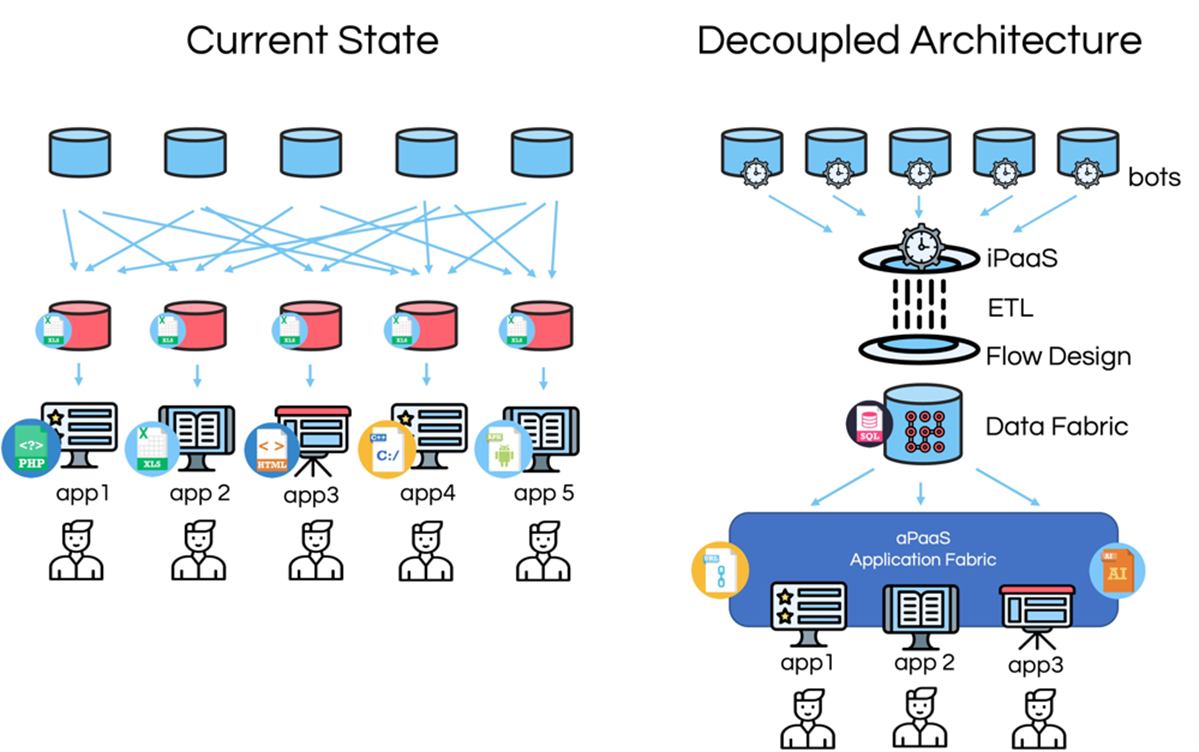
A data fabric is a conceptual data layer that spans your enterprise, releasing data from the applications and systems where data assets are found, to pre-process and organize it in such a way that it can be made useful for composing reports and be consumed by applications to facilitate machine-to-machine automation.
A data fabric solution creates a unifying data umbrella layer across your enterprise. It means data is presented in a ready-to-use format. Its main elements include:
1. Data Integration Tools to connect existing systems that hold data to the data ecosystem.
2. Extract, Transform and Load Technology to harvest and integrate with data sources, with added tools to design Master Data repositories.
3. Data Mashup Technology to pluck data from existing data sources into new structures and enrich with new data structures to meet new data demands.
4. Monitoring, Validation, and Data Integrity Tooling to ensure that data pipelines are working correctly to present data from endpoints while preventing corrupted or high-risk data from being accepted into the data fabric.
5. Analytical Tooling and Applications Development Software to consume data and present it for different uses.
A data fabric enables a new standard in data management, presenting data of high integrity that data scientists can use to automate processes and answer questions.
DIGITAL DOCUMENTS REMASTERED
Micro-Portals • Forms • Reports • Training Dashboards • Charts • Maps • Tables Checklists • Onboarding • Risk Registers • Presentations • eBooks
The terminology used in the data industry can be confusing. Here we try to unbundle the terms commonly used in data architectural discussions.
You create a Data Vault by designing a data taxonomy around core business intelligence ‘landscapes’ and the core data tables used to describe them. Typically, these are the core records that identify your customers, suppliers, risks, opportunities, projects, products, etc. This creates a structured model of your critical data assets. Then, data is normally ‘poured in’ to this by uploading it from its host system and transforming it into a unified single version of the truth. Data Vaults are typically created using either relational databases or flat-file ‘big data’ systems.
A data lake is a centralized repository built to store, process, and secure large amounts of structured, semi-structured, and unstructured data, storing data in its native format. It is a very specific technological construct that relies on cloud computing and big data technologies to manage vast amounts of aggregated data, organized into a pre-planned taxonomy. Back in the day, people would talk about data warehouses when thinking about a centralized repository, but cloud computing has changed the narrative. Whilst Data Lake technology is extremely powerful, it isn’t always practical or affordable.
A data fabric is less about an IT platform (as per a data lake) and more about an outcome: it describes the data mart layer used to make data valuable to the enterprise autonomous and composable. Your data fabric will contain business logic rules that dictate how data is shared, used, managed and consumed.
A data mesh is more about philosophy and the recognition that businesses have previously seen value in owning data (and thereby trying to control and manage it internally to their business), whereas now, it’s increasingly recognized that harnessing third-party data and sharing it can yield more data asset value. A data mesh exists therefore within, across, and beyond the enterprise as a federated data ecosystem.
A key strategic element of a data fabric architecture is the separation of the data layer from the application layer, fostering greater re-usability of both. Businesses looking to adopt a data fabric approach site one or more of the following objectives. To:
Overcoming the risks associated with the use of spreadsheets has become a widescale priority because of data security and privacy compliance. When data is used in spreadsheets, it becomes largely ‘invisible’ to those responsible for data governance.
Additionally, spreadsheets are costly to produce and manage because of the manpower overheads used to drive them.
Furthermore, spreadsheet files are prone to corruption and often contain formulas that only the creator understands, creating a single point of failure.
For all these reasons, industrializing information management by replacing spreadsheets with a robust and resilient data fabric architecture makes sense.
For organizations determined to reduce headcount and drive down back-office costs, removing the human in the loop is a prime driver for data fabrics.
While the importance of liberating data from data silos, spreadsheets, and increasing the pace of innovation are all good reasons for a data fabric architecture, there’s no question that most organizations will adopt it because it’s the only way for an enterprise to become truly data driven.
Ask anyone whether they feel well served by data and they will probably have their own horror story of having to use spreadsheets to harvest and manually crunch data to answer a question or solve a problem. Others will be using a spreadsheet as a quasi-business application because their IT team is too busy to find a robust alternative.
While the ambition to create a data fabric that spans the enterprise is a desirable one, getting to it can be costly. There will always be a need to achieve quick wins along the way. It’s likely that early-stage solutions will be solving problems at a departmental or functional level.
In this section, we’ve pulled together some examples of how data fabric architectures are being used to solve business problems. Applications for decoupling span the enterprise, although justifications for projects can originate at a departmental level, as illustrated by the examples below.
The sales division of a global electronics company responsible for the Middle Eastern, Eastern Europe, and African markets was being hampered by a shortfall in sales insights as the result of its widespread data silos. This meant the data-gathering process was time and effort intense.
Managers were presented with copious data but no actionable insights or recommendations for action. To resolve it, a data fabric was created across the regional sales platforms and ERP data repositories that could deliver timely actionable insights to stakeholders on demand. Read the full case story.
The management team of a progressive Office Equipment and technology business in Europe identified the need to become ‘data driven. The sales leadership wanted to create a single view of its customers to focus sales efforts on the most profitable opportunities and automate delivery processes. Read the full case story here.
Power and Energy is a fast-changing market. In the professional services industry, becoming adept at surfacing new advisory opportunities–also knowing what advisory services to offer and how to resource them–is critical to success. Find out how one global advisory firm used a decoupling architecture to gain a competitive advantage.
Codeless Platform-as-a-Service (PaaS) solutions take many forms. In the case of Encanvas, its codeless PaaS includes integration and application layers.
Integration, software bots, and Extract, Transform and Load (ETL) componentry bring data together in a data fabric.
Then, codeless software is used to design, publish and manage composed applications and machine-to-machine automations.
Removing the need to program system interfaces, specify information flows using scripts, and write code (or script) to create, publish and manage apps substantially cuts the time and effort needed to implement an effective data fabric and application fabric: the two building blocks of a modern Composable Data Architecture.
When organizational priorities for IT are dictated by departmental managers seeking to address operational challenges with point-specific solutions, this inevitably leads to more data silos and a whole series of missing pieces in data architectures.
One of these is the vital framework of data bridges that link data elements together. It’s not uncommon, for example, to find an enterprise resource planning and customer relationship management solution using different fields to identify a customer. Equally, financial systems may not be correctly configured to identify product or service line profitability. When such data relationships are absent, it’s not possible to ask ‘what-if’ questions that combine multiple data sources, without first bringing data together into a new structure.
Another missed opportunity is the ability of an enterprise to understand its digital DNA. This is the data that helps an organization define itself, such as the organizational structures, locations, people, processes, suppliers, systems, risks, and data elements that define an organization’s makeup and capability.
Businesspeople have been waiting for the day when they could ask what-if questions and access the data they need to do their jobs more efficiently. Businesses want to be data-driven, implement automation at scale, tie front-end and back-end systems together to serve customers better, and bring transparency to data processing. All these ambitions rely on access to useful data. Consequently, conversations around data services have moved beyond slow-to-build data warehouses and crude point-specific solutions powered by spreadsheets. Enterprise IT has become less about systems and more about data asset value and reuse. The good news is that codeless PaaS technology makes the implementation of a data fabric affordable as it takes far less time and effort to overcome the issue of data siloes.
In most digital industries, competitiveness comes down to customer experience. To achieve simpler customer journeys, more self-service, faster turn-arounds on orders and requests, to adapt faster to market needs, etc., all these outcomes rely on having faster access to more useful data. Achieving data virtualization by releasing data from systems that hold it to ransom through the formation of a data fabric holds this promise.
Whilst the technology is certainly catching the headlines, it would be wrong to assume that harvesting everything into a data lake is a complete or fool proof solution. There are many wheels to the data fabric wagon and getting data into a single ‘place’ may be a misguided outcome priority for some organizations. Sometimes, there are quicker wins to be gained by delivering data fabrics across departments and solving a handful of high-priority projects.
DIGITAL DOCUMENTS REMASTERED
Micro-Portals • Forms • Reports • Training Dashboards • Charts • Maps • Tables Checklists • Onboarding • Risk Registers • Presentations • eBooks
Building enterprise software has never been easier thanks to advances in cloud Low-Code, No-Code, and Codeless aPaaS applications platforms.
How digital documents deliver small and wide data, allowing data-driven enterprises to optimize their business models and efficiency,
In this article, find out about our enterprise digital data fabric platform, what it is and why your business needs one.

The desire of most digital businesses is to make informed decisions driven by rich data analytics. In this article, we explore how digital documents are helping to achieve that.
Tonis Haamer is one of the cleverest businesspeople I know. He runs a Overall Eesti, technology business in Estonia along with his brother, Mart. Still today, a big part of the business is office equipment, the company’s heritage. But the market for office printing is not what it was, and this caused Tonis to realize that the onward growth of the business demanded a rethink in how it is resourced.
Now, Overall Eesti is a very people-centric business. The team behind the brand is extremely hard working, extremely loyal. Shedding staff wasn’t a desirable go-forward plan. For this reason, Overall Eesti began its journey to become data driven, and one of the most advanced digital businesses.
I had the opportunity to interview Tonis on behalf of Canon Europe when I was running strategy around software solutions for the brand. I was looking to see how companies are adopting data insights, and Overall Eesti was an example.
Over a couple days, Tonis explained the objective behind the company’s data driven agenda was to make smarter decisions more often to answer new questions as they emerged, and to reinforce sub-optimal processes with new applications built using digital documents when it became obvious there was an opportunity to streamline.
Tonis explains, “To be data driven means being able to answer new strategic questions as they emerge. To do that means you have to harness your operational data that comes from ERP, service, CRM, HR, and other front-line business systems. It demands the ability to re-use this data for new purposes. And the challenge that brings with it is how to get the quality and integrity right. Once you’ve achieved that, the possibilities open up. But it is not a trivial task to create composable data.”
Almost a decade ago, Overall Eesti became one of the first companies in the world to create a home-grown Digital Data Fabric they called ‘CLIO.’
As Tonis explains, “Preparing your data is one of the biggest technical challenges of creating a data driven approach to business. It’s not just about harvesting the data you already have. Almost inevitably there will need to be enrichment of data, and you suddenly realize how poor the quality of data is from systems that only use aspects of the databases designed to support their operation. Furthermore, we found that some of the key links between data-sets did not exist. We had to find ways of connecting records in one system with the next by using fuzzy logic matching to construct the relational ties that were missing.”
As an early adopter of data fabric technology, the Overall management team are very familiar with the journey to overcome technical challenges, but Tonis is clear that data quality is only a foundational stone of a broader change agenda.
It starts with rewiring the culture of management towards the importance and use of data. This, and understanding what the strategic priorities are and what questions remain unanswered. You need these three qualities: clarity of purpose, data culture, and data integrity all in place before you start to see returns for your investment. For many businesses, the cost and complexity of that change has discouraged them from moving forward.
Digital documents, and the data fabric they reside on, offers the necessary blend of tooling for organizations to become data driven. These technology instruments are important, but—as this case example implies—overcoming the cultural, behavioral and strategic planning challenges may still yet be the greater obstacle to success for business leaders prepared to give the data driven business model a try.

We live in a data driven business world. How do you tap into yours?
It’s thought Jeff Bezos was the first person to use the term Innovation Value Management (IVM) to describe data as a business asset based on its contributory value. If it wasn’t Jeff, then it was probably one of his team. Amazon is passionate about the value of its data. The company leadership team knows that capturing rich insights on its customers—their buying preferences and behaviors—offers an unrivalled competitive advantage.
When organizations shape their management approach to use data every day to make decisions, they are often described as operating a data driven culture. Organizations want to maximize the value of their data by using it to make business decisions. It’s never been more possible thanks to cloud computing and big data. And yet, the secret of driving business success through data often has more to do with the attitudes and skills of your people, than the technology they use.

Businesses that transition decision making to be evidence based, need curious minds to power change. Individuals at all levels of the enterprise must as the question ‘Why’ more often, and have data and analytical tooling at their disposal that equips them to rapidly find answers to those questions. In the digital age, a spreadsheet doesn’t quite cut it. You will need data harvesting and visualisation tools. More over, you will need data to be organized correctly in the first place, and probably cleansed of impurities. This is where low-code software apps come in.
Many of the new executive roles are analytics based. For example, in the office equipment industry, the transition to data-driven business has led many vendors to appoint Service Managers with an analytical background where previously, these roles were fulfilled by ‘the best field service engineers.’ Such roles today are largely about understanding patterns in data, managing people, and acting on escalations.
The latest research from Gartner suggests that, by 2023, data literacy will become an explicit and necessary driver of business value, demonstrated by its formal inclusion in over 80% of data and analytics strategies and change management programs.

Data has become the lifeblood of enterprise. Executive management teams are taking more of an active ownership role in BI initiatives than ever before. Once the bastion of large corporations—because they were the only community of business able to afford the extremely high price tag—business intelligence has become democratized over the last decade thanks to affordable ‘pay-as-you-use’ applications and cloud-based technologies that scale accessibility and affordability to dashboarding and data warehousing tools. What low-code software apps do is fulfil the ambition that many executives to further democratize business intelligence to every stakeholder in the enterprise, and potentially beyond it.
Creating a data driven ‘curious’ culture will help your business to understand customer behavior, react to market changes faster than your rivals and eliminate the unknowns. What organization would not want these abilities?

Armed with a new set of ambitions, organizations are establishing leadership roles to drive the transition of people, process, technology and data to evolve a data driven culture. The Chief Data Officer (CDO) role is growing in popularity as a standard bearer. According to the latest research from Gartner, this role is intended to:
In a digital era, businesses operate on data. Much of their opportunity is programmed into inbound marketing schemas and their operational performance depends on data analytics to execute hundreds of decisions based on fact—not gut-feel—to fine-tune internal processes and minimize sales costs. To create a data driven culture requires a culture change in many management teams that are accustomed to driving their business based on ‘hunches’ and ‘best guesses’ over what customers value and what they want. A digital economy means that enterprises no longer need to guess.
Jeff Bezos, the founder of Amazon is quoted as saying, “If you don’t understand the details of your business you are going to fail.”
The most commonly reported barriers to a data driven culture are:

The transition from analog to digital business behaviors has been swift; a matter of a few years. Many enterprises find themselves on the wrong side of this wave, operating without good customer, product, business or market insights. They find their operations somewhat sluggish compared to the ‘SaaSy’ new-kids on the block. Executives know, curious minds are needed to fast-track change at every level of the organization.
Attitudes to data vary across businesses. Leaders generally see it as crucial and an opportunity, while many departmental leaders find it a tantalizing prospect that’s probably out of reach. IT leaders, on the other hand, see data as a problem and a risk. And there will be many that see the surfacing of operational data as a risk, given that it might expose their underperformance. Bringing everyone on the same page will not be easy, but it is necessary to remain competitive in a digital economy.
Creating a data driven culture is a change project like any other. To be successful, your business needs to be armed with the same state-of-the-art methods and tools that your competitors will be using. Nothing less will do. That means harnessing robotics and artificial intelligence, analytical visualization tools, predictive modeling and automated escalation routines.
Unfortunately, when considered in isolation, none of this technology will actually help your business to harvest its opportunity and grow. Like most changes in business, it will take a blend of ‘people, process, data and technology’ to become a successful data-driven enterprise—and the need to change attitudes and behaviors will as always take center-stage.

Ian Tomlin is a management consultant and strategist specializing in helping organizational leadership teams to grow by telling their story, designing and orchestrating their business models, and making conversation with customers and communities. He serves on the management team of Encanvas and works as a virtual CMO and board adviser for tech companies in Europe, America and Canada. He can be contacted via his LinkedIn profile or follow him on Twitter.
Now read:

Without data, you’re just another person with an opinion
W. Edwards Deming, American Statistician
Data matters and it’s central to digital transformation. The problem is no matter how much companies invest in their data, and however they capture it, the quality will always be suspect. Without data, any ideas of digital transformation are likely to be a pipe dream. Low-code is transforming the ability of organizations to create custom apps to cleanse, organize and use their data.
Most companies hoard gigabytes of data on their finances, their products, their customers and markets. The difficulty is that almost no enterprise has its data organized in a structure that makes it easy to access. As soon as business leaders come up with ideas for business model re-invention, probably the next thought in the minds of DevOps leaders is ‘Where is the data coming from?’
Digital transformation projects have a habit of either generating new data (as in the case of sensor network-centric projects) or re-using old data (such as plotting assets or customers on a map and gaining value from location-centric perspectives), or a blend of the two. Re-using data found within the enterprise can be challenging because of data quality issues, the variations of data structures and field formats between applications, and issues getting data out of systems. This means DevOps teams need to have very good data management skills. Low-code platforms offer a smart new way for these teams to harness data that is close by but remains out of reach
How should DevOps teams approach their data challenges? Here are 10 ways DevOps teams are using Encanvas to breathe new life into their old data.
Old data may be held in various applications and formats. It’s not uncommon for Encanvas to gather information from spreadsheets, big back-office systems databases like SAP R3, IBM DB2, Microsoft Dynamics and SQL – all at the same time. Encanvas is a plug-and-play multi-threaded and multi-sourcing platform which means designers can create concurrent live data feeds from multiple systems or end-points at the same time. This capability is used extensively by designers when creating applications that re-use data from existing and new systems together, creating new data structures on the fly for the specific canvases they author as part of applications under development.
Your old data may require filtering to select only the records relevant to your project. A powerful feature built into Encanvas’s mashup environment is our special filter which allows designers to employ drag and drop controls to instantly create very powerful data filtering on inbound data from third party sources. Any number of filters can be applied to tables at the same time. For example, if a designer wants to only ingest data from a customer table of a specific type, and that relates to a specific region, they can create special filters for ‘types’ and ‘regions’ selecting only the records that apply to those conditions. All of this rich configuration is done without any coding and doesn’t influence the integrity of the ingested table, or the potential re-use of data in its native form by other applications (or canvases).
Old data may be held in various applications and formats. It’s not uncommon for Encanvas to gather information from spreadsheets, big back-office systems databases like SAP R3, IBM DB2, Microsoft Dynamics and SQL – all at the same time. Encanvas is a plug-and-play multi-threaded and multi-sourcing platform which means designers can create concurrent live data feeds from multiple systems or end-points at the same time. This capability is used extensively by designers when creating applications that re-use data from existing and new systems together, creating new data structures on the fly for the specific canvases they author as part of applications under development.
If your old data can benefit from being enriched by other sources of data, Encanvas’s mashup capabilities can really bring value by making the internal and external data accessible to applications designers without having to use coding or API to build new integrations.
Sometimes old data requires cleansing at the point of transfer from its original location using a machine to machine cleansing and transforming process to shed unwanted data and apply transformation rules to re-order, de-dupe and re-locate data to new data structures. Encanvas Software Robots make possible machine-to-machine integrations. They equip designers with the means to configure ETL actions and normalize data before it gets ingested into applications. Our software robots also automate the generation of notices to alert designers (and users too if necessary) that transformations have worked – or not. Transformations can be triggered by events, scheduled times, watch folder changes and a variety of other means.
A powerful (and pretty unique) feature of Encanvas lies in its ability to create quarantining protocols for old data that fails to live up to your expectations for data integrity. There are few good reasons to upload records that are unfit for purpose. If you are gathering customer records for example and would determine that records that fail to have any contact email, telephone or mobile numbers included are not suitable for use, then designers can create quarantining rules that filter this data out for special treatment. In such cases, the data remains ‘in the system’ but is no longer visible to users until it has been manually or machine cleaned.
It may be that old data is being ingested from multiple systems or end-points and you need to create a new data mart that has to prioritize the best likely source of good quality data over others. This can get really complicated because different systems may create new data at different speeds and this can create latency issues but, nevertheless, Encanvas has the codeless tooling to enable designers to author voting systems to vote on which source is most trusted. Voting systems can use algorithms to automatically test data integrity and then automatically augment the voting structure, or they can be manual, where the data owner or manager uses a sliding scale of trust levels to determine which source is proving to generate the best results (or both!).
When there are gaps in your old data, there are many ways that Encanvas can create new data as part of its application design. For example, the numeric controls of Encanvas allow designers to create formulas and calculations on data to total columns, sum value, source averages etc. that may be required for your new dashboards and reports but do not exist in the ingested data. Encanvas also has the ability to ingest SQL script and DLLs to make it easy for DevOps teams to re-use existing code blocks or create new APIs and transformations.
Another way to create new data is by using Encanvas’s mapping capabilities to apply location-data to existing addresses and locations. Encanvas has an integrated – and codeless – mapping engine (sometimes referred to as Geo-Spatial Intelligence, or ‘GIS’). It allows designers to plot and pin records on maps. The geo-data of records is added to the data-set (companies like Google and Microsoft charge lots of money to do this!).
Parachute in a high profile technology-centric team with a strong leader into an organization with an existing IT department it’s hardly surprising that you’re going to have to put out some fires and smooth over a few ruffles.
Balancing two-speed IT means having an internal IT team focused on reducing costs and improving process efficiencies through Business Transformation (BX) and a DevOps team re-inventing business models through Digital Transformation (DX) in tandem. Recognizing each team for its own skills and contributions to business outcomes and balancing praise is going to be important for a healthy culture.
We’ve saved the most dramatic way of fixing old data quality issues until last – because it’s no small project to build a new data warehouse to gather and re-organize data into new structures but sometimes it’s the most sustainable way to ensure that data integrity is preserved for the life of your application. For mission-critical processes, it’s probably the best quality outcome although the time and investment needed to create a data warehouse or enterprise data-hub are definitely ‘none trivial’. Encanvas includes all of the codeless tooling needed to fast-track the creation of new data warehouses and data marts using the data repository of your choice – whether you are moving towards a big data solution like Hadoop or are seeking a more traditional data structure like SQL or DB2.
So there you have it – ten ways Encanvas Low-Code can help you to turn old data into useful data for your next digital transformation.
To find out more about the capabilities of the Encanvas Low-Code platform, please contact our team.

Author
Francesca is an independent writer and head of communications for technology brands. Armed with a passion for writing about innovative technologies that can transform business, she serves on the management team of Encanvas and also works as a consultant and advisor to the executive teams of PrinSIX Technologies, Answer Pay and INTNT.AI, helping to rethink their marketing in order to tell their brand story. She can be reached via LinkedIn.

A decade ago, data was interesting, useful maybe, but not always business-critical. There were ways around the problem of not sharing data. Executives could always drag someone into an office and interrogate them for answers to their questions, marketers could run forums and research projects and count on a reasonable number of willing customers or prospects to take part, salespeople could still pick up the phone and cold call their prospects.
Not today. The tempo of business changed when things went online. As eCommerce has grown, data volumes have exploded, and smartphones have increased in volumes beyond the size of our populations. With the introduction of 5G telecommunications, we are experiencing a hundred-fold increase in download speeds which means that it’s comfortably possible for me to operate a Chromebook laptop computer connected to a cloud-based repository without housing all of the apps and files I need on a hard-disk. In a world with so much data, moving at light-speed is it any wonder that companies can no longer envision their managers crunching data on spreadsheets and thinking that it’s good enough? Conversations have moved towards data literacy and how to establish behavioral norms that install data analysis as a precursor to every decision.
The growing importance of data-driven cultures Data has moved to the heart of boardroom discussions around how to achieve a competitive advantage. The latest research from Gartner suggests that, by 2023, data literacy will become an explicit and necessary driver of business value, demonstrated by its formal inclusion in over 80% of data and analytics strategies and change management programs.
Data has become the lifeblood of the enterprise. Executive management teams are taking more of an active ownership role in BI initiatives than ever before. Once the bastion of large corporations—because they were the only community of business able to afford the extremely high price tag—business intelligence has become democratized over the last decade thanks to affordable ‘pay-as-you-use’ applications and cloud-based technologies that scale accessibility and affordability to dashboarding and data warehousing tools.
Armed with a new set of ambitions, organizations are establishing leadership roles to drive the transition of people, process, technology, and data to evolve a data-driven culture. The Chief Data Officer (CDO) role is growing in popularity as a standard-bearer. According to the latest research from Gartner, this role is intended to:
To create a data-driven culture requires a culture change in many management teams that are accustomed to driving their business based on ‘hunches’ and ‘best guesses’ over what customers value and what they want. A digital economy means that enterprises no longer need to guess.
Jeff Bezos, the founder of Amazon is quoted as saying, “If you don’t understand the details of your business you are going to fail.”
In a digital era, businesses operate on data. Much of their opportunity is programmed into inbound marketing schemas and their operational performance depends on data analytics to execute hundreds of decisions based on fact—not gut-feel—to fine-tune internal processes and minimize sales costs. Creating a digital culture requires a re-think in technology, people, process and data management. This is where companies like NDMC Consulting come in; to help enterprises navigate their transformational journey. Encanvas Secure&Live is an example of an application software platform designed to equip businesses with a digital culture to make decisions based on data.
Creating a data-driven culture will help your business to understand customer behavior, react to market changes faster than your rivals and eliminate the unknowns. What organization would not want these abilities?
The transition from analog to digital business behaviors has been swift; a matter of a few years. Many enterprises find themselves on the wrong side of this wave, operating without good customer, product, business or market insights. They find their operations somewhat sluggish compared to the ‘SaaSy’ new-kids on the block.
The most commonly reported barriers to a data-driven culture are:
Attitudes to data vary across businesses. Leaders generally see it as crucial and an opportunity, while many departmental leaders find it a tantalizing prospect that’s just out of reach. IT leaders, on the other hand, see data as a problem and a risk. And there will be many that see the surfacing of operational data as a risk, given that it might expose their underperformance. Bringing everyone on the same page will not be easy, but it is necessary to remain competitive in a digital economy.
Creating a data-driven culture is a change project like any other. To be successful, your business needs to be armed with the same state-of-the-art methods and tools that your competitors will be using. Nothing less will do. That means harnessing robotics and artificial intelligence, analytical visualization tools, predictive modeling, and automated escalation routines. Unfortunately, when considered in isolation, none of this technology will actually help your business to harvest its opportunity and grow. Like most changes in business, it will take a blend of ‘people, process, data and technology’ to become a successful data-driven enterprise—and the need to change attitudes and behaviors will as always take center-stage.
Encanvas is an enterprise software company that specializes in helping businesses to create above and beyond customer experiences.
From Low Code to Codeless
Better than code-lite and low-code, we created the first no-code (codeless) enterprise application platform to release creative minds from the torture of having to code or script applications.
Use Encanvas in your software development lifecycle to remove the barrier between IT and the business. Coding and scripting is the biggest reason why software development has been traditionally unpredictable, costly and unable to produce best-fit software results. Encanvas uniquely automates coding and scripting. Our live wireframing approach means that business analysts can create the apps you need in workshops, working across the desk with users and stakeholders.
When it comes to creating apps to create a data culture and orchestrate your business model, there’s no simpler way to install and operate your enterprise software platform than AppFabric. Every application you create on AppFabric adds yet more data to your single-version-of-the-truth data insights. That’s because, we’ve designed AppFabric to create awesome enterprise apps that use a common data management substrate, so you can architect and implement an enterprise master data management plan.
Encanvas supplies a private-cloud Customer Data Platform that equips businesses with the means to harvest their customer and commercial data from all sources, cleanse and organize it, and provide tooling to leverage its fullest value in a secure, regulated way. We provide a retrofittable solution that bridges across existing data repositories and cleanses and organizes data to present a useful data source. Then it goes on to make data available 24×7 in a regulated way to authorized internal stakeholders and third parties to ensure adherence to data protection and FCA regulatory standards.
Encanvas Secure and Live (‘Secure&Live’) is a High-Productivity application Platform-as-a-Service. It’s an enterprise applications software platform that equips businesses with the tools they need to design, deploy applications at low cost. It achieves this by removing coding and scripting tasks and the overheads of programming applications. Unlike its rivals, Encanvas Secure&Live is completely codeless (not just Low-Code), so it removes the barriers between IT and the business. Today, you just need to know that it’s the fastest (and safest) way to design, deploy and operate enterprise applications.
Learn more by visiting www.encanvas.com.
Ian Tomlin is a management consultant and strategist specializing in helping organizational leadership teams to grow by telling their story, designing and orchestrating their business models, and making conversation with customers and communities. He serves on the management team of Encanvas and works as a virtual CMO and board adviser for tech companies in Europe, America, and Canada. He can be contacted via his LinkedIn profile or follow him on Twitter.
Gartner – Why a data culture is important
Wikipedia article on Data Culture
CIO article – the four stages of data maturity