EXPERIENCE ENCANVAS IN 60-MINUTES!
We’re always happy to walk you through Encanvas no matter where you are in the world.


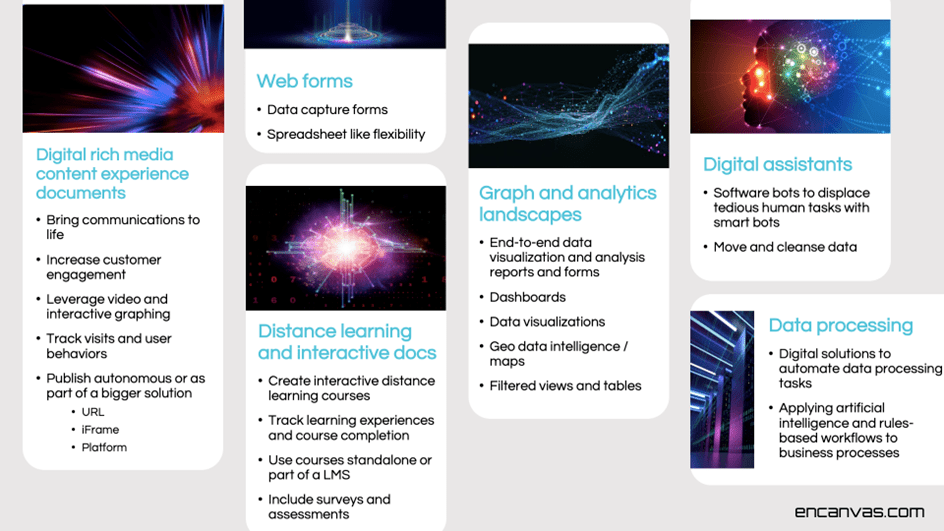
Digital documents are a revolutionary tool enabling digital transformation for businesses. Discover some of the types of digital documents you can create using Encanvas.
Content experience documents are all about engaging audiences in more impactful ways. A digital brochure (or eBook) combines rich media to produce persuasive, professionally crafted digital content. Rich media content—containing elements such as videos, testimonials, facts presented through interactive graphics, visualizations, etc.—increases stakeholder engagement, and improves customer experience, maximizing information consumption and use.
According to research into the opinions of 538 digital marketers conducted by Lemonlight in 2021, 81% plan to include video content in their marketing strategy over the next several years, while 94% said watching video content has helped them make a purchase decision at least once. Of those, 72% were swayed by a product video.
Distance learning has transformed education. Digital courseware makes it faster and easier for courseware designers to design and publish courses. Furthermore, once published, digital courseware is a lot easier to update. One of its advantages comes from the ability to track learning journeys; sometimes, recording training and training results is essential for compliance.
Digital documents bring distance learning course development into the digital age. Take existing PowerPoint courseware and upgrade it to digital online courses in minutes. Use courses stand-alone or leverage an eLearning platform to manage them.
Web forms are another digital document example, as they’re used to capture data from customers and turn back-office processes into self-service experiences. Automating processes in this way not only improves customer experience by making more services on-demand but also increases customer engagement while reducing service costs.
Often, human-in-the-loop processes are re-engineered with the minimum amount of effort or fuss. Having captured data, workflow rules can be automated by software bots that also track and record customer interactions into Customer Data Platforms.
We’ve made forms integration with websites simpler too. Using Encanvas digital documents, web forms can be implemented as stand-alone solutions or be closely integrated with existing data repositories. Publish forms as secured permissions-based iFrames within existing websites, or link to public or private forms using dedicated URLs for direct access.
Software bots are great at recording transactions, making ‘micro-decisions’ across the enterprise, for harvesting and cleansing data, and moving it between locations. Many of the tedious tasks previously performed by humans and spreadsheet-powered data processing applications can be displaced by enterprise-grade IT solutions made possible by digital documents.
While spreadsheets are versatile, they’re also labor-intensive. Give your knowledge workers more time to deliver value to customers and make a positive impact on innovation and business improvements by displacing spreadsheet apps with enterprise-grade digital document solutions. Our digital documents are powered by robots. That means, much of the heavy lifting that humans have previously done to capture, process, manage and analyze data can be discharged by software bots through automation.
Is your eCommerce front-end website fully automated with back-end systems? If so, then you’re ahead of the curve! Most organizations have a portion of their back-office data processing that goes ‘offline.’ This adds costs to service delivery costs while delaying customer requests and responses. Bottlenecks emerge and customer experience decays. The alternative is to use digital documents to bridge between systems and processes to create a ‘fully digital’ environment. The ability to leverage digital technologies to dramatically escalate time to value for digital transformations is increasingly being described as hyper-automation.
The possibilities to present and make sense of data using rich data visualization tools have grown dramatically thanks to innovations in cloud computing and big data tooling. Visualizations might come in the form of interactive maps used to track assets, parcels, people, vehicles or drones, or spatial charts and graphs that highlight key data attributes that would otherwise remain hidden to users.
Arguably, the single biggest reason businesses invest in enterprise IT is to formalize and automate processes. Not so long ago, the way to do this was to invest in Systems of Record (SoR)—like Oracle, SAP, and Microsoft—that promised best practice data processing ‘templates’ that catered for the majority need and offered the assurety of robust and resilient data management and processing.
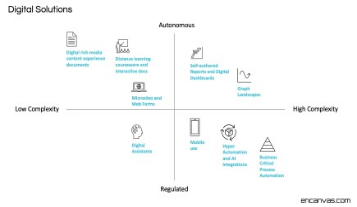
Building enterprise software has never been easier thanks to advances in cloud Low-Code, No-Code, and Codeless aPaaS applications platforms.
How digital documents deliver small and wide data, allowing data-driven enterprises to optimize their business models and efficiency,
In this article, find out about our enterprise digital data fabric platform, what it is and why your business needs one.
 This document highlights five major reasons to invest in an enterprise platform like Encanvas that supports the lifecycle of digital documents.
Documents have always been useful to businesses. They are easy to create and use, perform countless roles—by making information easier to capture, process, distribute, share, and store—and, perhaps most importantly, they are a familiar concept that people understand.
Read our article on digital documents and innovation
The use of intelligent digital documents is on the rise, responding to the demands of digital business. This new digital file construct—that combines document data with design and logic rules whilst still remaining largely autonomous in its use—is breathing new life to the role of documents in businesses.
Digital documents are a form of what Gartner calls a composable application. (Interestingly, composable applications come #5 in Gartner’s top 2022 priorities.)
They are built from business-centric modular components and make it easier to use and reuse data and code, accelerating the time to market for new information solutions and releasing enterprise value.
According to the Gartner report “Adopt a Composable DXP Strategy to Future-Proof Your Tech Stack,” 60% of mainstream organizations will use the composable business model as a strategic objective by 2023.
While digital documents are considered to be essential in the democratization of IT, their autonomy of use is not without rules or governance. Indeed, IT teams have greater control and governance over digital documents than they enjoy with the self-authored apps of citizen developers. But, what this autonomous use does bring is an insane level of versatility in the range of information publishing, management, and processing use cases digital documents can deliver across your business.
Read about intelligent digital documents
Demands for agility come from the recognition that markets and business models are changing progressively faster. To see change as an opportunity, not a business threat requires an organization to see the need for agility as a constant. This agilization of the enterprise covers all areas including decision-making culture, supply chain, resourcing, people, and not least systems and processes.
The Nordics arm of Deloitte’s took the time in 2021 to conduct detailed research into the importance of business agility to leaders and found that 67 percent of respondents saw business agility as having a high priority across their organization.
Composable technology, like digital documents, cascades access to information—and information sharing and processing tooling—across the enterprise, allowing departments and individuals to craft better ways to analyze data and get things done without calling on IT every time a spreadsheet isn’t the answer.
According to the Gartner report “Adopt a Composable DXP Strategy to Future-Proof Your Tech Stack,” 60% of mainstream organizations will see the composable business model as a strategic objective by 2023.
Tech talent is hard to find, and the competition is so fierce, leading to a 14% upshift in operating costs in some US states. Meanwhile, in the UK, the Department for Digital, Culture, Media and Sport (DCMS) report on the tech skills gap suggests that data analysis is the fastest growing skills cluster in tech and is set to expand by 33% in the next five years.
Applications developments are high-risk and costly. Everyone knows it. Still, the move to make tech solutions—such as mobile apps—an integral part of the customer value offered by digital businesses means every IT function today has a long tail of app dev demands.
Thankfully, digital documents aren’t quite the same as apps. They are more autonomous. They are truly codeless. And, they combine with cloud-native digital cloud spaces and digital data fabrics to allow IT, teams, to retain control over their tech stack, even while providing business stakeholders with the information solutions they need. That’s good news when there’s a global shortage of tech talent.
Watch any video of Bezos talking about business, Amazon’s growth, or his own life lessons, and within seconds he will inevitably talk about customer-centricity and the value Amazon derives from data. Extracting value from data—not just gathering it—is critical to any digital business. And it’s in this second phase of ‘harvesting value from data’ that digital documents bring real value.
The challenge most companies face when it comes to data value is threefold:
Digital documents allow executives and information workers to fully leverage the data at their disposal to answer new questions as they emerge. Additionally, digital documents can capture further enrichment data associated with a subject—by cross-fertilizing with third-party data or adding custom data fields—that brings more value to data.
Since the birth of enterprise computing, the focus on data processing and its use has seesawed between centralized and distributed systems.
This pendulum has been about leveling up cost, availability, and control over IT. That is to say, finding the ideal state between these three core considerations has never been easy.
The general shift over the past few years—thanks in part to cloud computing and big data—has been a move to large-scale centralized processing. But centralized economies and the assumed advantages in data and systems governance served up by cloud computing result in less autonomy and access for information workers to harness and adapt technology to serve business needs at the edge of the enterprise.
The overriding reason digital documents are facing a high pace of adoption within enterprise technical teams comes down to their ability to apply a new and practical balance between business demands and IT priorities.
Since the digital economy landed—and started to place unreasonable demands on IT teams whose resources were already overstretched by business continuity, compliance, and renewal challenges—there has been an unquenchable demand from front-line enterprise departments for more applications. This is hardly surprising; the consumerization of IT made it plain to many businesspeople that the quality of the software they were being served up and asked to live with was far behind the curve of what companies like Google and Facebook were serving up to consumers for free. Information workers of the 1990s were frazzled by having to work late nights with spreadsheets, while fully aware that their databases were perfectly capable of achieving more in less time, and with less hassle.
Digital documents offer digital workers empowerment; that much is reasonably obvious: They don’t have to go to the IT department door with a begging bowl for new applications to work with data. What is less obvious, is how game-changing digital documents are for IT teams. While digital documents are convenient and accessible to the mass of workers in a digital business, for IT professionals with skills, there are no limits to the possibilities to innovate, whilst throwing a veil of robust IT protocols across the enterprise to improve control, data security, applications governance, replication, and scaling safeguards, etc.
Above all, digital documents form a thoughtfully designed balance between the needs of the business, and the needs of IT; one that favors both parties.

New intelligent digital document formats like Encanvas CDF are set to transform the citizen developer landscape. Find out how.
Back in 2021, Gartner projected the worldwide low-code development technologies market is projected to total $13.8 billion in 2021, an increase of 22.6% from 2020, according to the latest forecast by Gartner, Inc. Check out the valuations of players in this space, and you soon realize citizen development has boomed.
With all this money floating around, you would think citizen development is the way to go. Low-Code and No-Code applications development has certainly moved forward in the last decade. Even players like Microsoft, Salesforce.com and Oracle boast low-code appdev tools in their offerings these days. The drive for these apps comes from an unrelenting demand for new apps from business leaders and digital workers.
Demand for applications development has spiked thanks to the emerging demands of digital business. Nowadays, it’s not just a question of running a few back-office systems of record to keep the lights on in the business.
IT teams are faced with having to produce custom apps for customers, custom apps for departmental leaders hungry for data insights, custom apps for digital workers fed up with crunching data on spreadsheets or using hard-copy documents to make back-office processes work.
There is not just one market for low-code and no-code citizen development tools, there are several. Many aspiring entrepreneurs are looking to create their own custom software apps to serve new digital business models. Equally, there is a large audience of seasoned IT professionals out there, looking for simpler, faster, smarter ways of producing applications. Perhaps though, the largest target audience for citizen development comes from enterprise department managers who are chocked off with IT constantly telling them they can’t have new software tools to automate their processes, displace tedious tasks with robots, or useful business analysis tools to serve up the data insights they need.
Finding a way to source the digital tooling they need to get their job done in a digital business has driven many a business professional to serve themselves with a custom app. Although, my experience of this community is that the overriding majority never had a craving in their life to become a software developer.
What digital workers want are the tools to get their job done in a digital age. And—with the evolution of digital documents—there’s no need to stress out the IT team, or put data at risk to achieve that.
According to Gartner, the latest trends in enterprise IT focus on the need of organizations to adopt ‘composability’ in their enterprise software architectures and business cultures.
Gartner defines business composability as “the mindset, technologies, and set of operating capabilities that enable organizations to innovate and adapt quickly to changing business needs.
A key construct of a composability architecture is what they describe as a data fabric: “..a design concept that serves as an integrated layer (fabric) of data and connecting processes. A data fabric utilizes continuous analytics over existing, discoverable and inferenced metadata assets to support the design, deployment and utilization of integrated and reusable data across all environments, including hybrid and multi-cloud platforms. Data fabric leverages both human and machine capabilities to access data in place or support its consolidation where appropriate.”
It’s not often I agree with Gartner. We’ve had a few fall outs over the years. Generally, this has happened when they’ve suggested an enterprise IT market is going to grow like topsy only to turn out to be a damp squib. Nevertheless, on this occasion, I do agree with Gartner.
If digital businesses are to make data useful—composable—it has to be prepared for consumption, and that means building out the data harvesting, sorting, connecting, organizing, de-duping, transforming, mashing, etc. digital data fabric first before it can be used.
Digital document architectures for the enterprise contain three layers:
#1 Digital Documents
Designed to equip digital workers to get their jobs done in a digital age, digital documents are a new codeless technology construct.
A digital document is an intelligent composite data file that performs the familiar duties of traditional hard-copy documents in the enterprise. Digital workers use them to capture, manage, analyze and communicate with data.
Unlike DIGITIZED document formats like Portable Data Format (PDF) from Adobe, the DIGITAL Canvas Document Format (CDF) from Encanvas brings together all the elements of digital documents—data, user interface (UX) design, if/then logic, presentation and transition rules, design elements, governance (including management, distribution, ownership and archival rules, etc.)—in a simple intuitive format that’s easy to learn and use. Furthermore, canvases can be used in an autonomous mode as standalone documents (which is empowering for digital workers), or interpolated together to fulfil complex information processing functions across and beyond your business. Put digital documents in the hands of digital workers and they can get their work done. Place them in the hands of IT professionals, and you can build practically anything without coding.
Digital documents are key to helping IT teams rollout digital innovation to the edge of their enterprise. For example, composing new AI and software bot powered digital documents creates smarter, more responsible, scalable AI. This enables better learning algorithms, interpretable systems and shorter time to value promoting productivity and agility.
#2 Digital Data Fabric
A data fabric that takes care of the complex data integration, cybersecurity, management, governance and processing tasks that are needed to install robust enterprise-grade IT solutions. Our digital data fabrics maximize data value by simplifying integration challenges and reinforcing Master Data Management (MDM) rules; reducing the replication of data assets, minimizing data complexity, and speeding up time-to-market of new digital document applications.
#3 Digital Cloud Spaces (aPaaS)
The safest way to control digital documents used in the enterprise is to manage published content in data safe containers, protected by rigorous information security policies. Digital Cloud Spaces are, in essence, private cloud containers offering unprecedented cybersecurity, governance and scaling capabilities. Using Digital Cloud Spaces, Digital Data Fabrics coexist on the same private cloud and easily managed and replicated. All of the functionality you would expect in a modern private cloud application Platform-as-a-Service—including the app configuration and governance tooling—comes as part of this cloud native technology componentry.
The major reason why digital documents are promoted by CIOs and CTOs comes from their ability to set a suitable balance between self-serving digital workers and the IT governance and data security teams found in the IT department. With digital document architectures, IT professionals are always in control of system and data architectures, data endpoints, integrations, etc. They have more visibility over user behaviors and the end products fashioned by digital workers. They can step in when they’re needed, and step back when they’re not.
Digital documents afford IT teams with seismically higher level of control and governance over enterprise systems, data and security when compared to citizen app development solutions.
That’s a good question, and not one any person can answer probably at this stage. Certainly, there are advantages of digital documents over low-code solutions—i.e., more autonomy for digital workers, faster adoption times, greater scalability, lower risks and overheads to IT teams, simpler data integrations, more control and governance, lower demands on tech competencies etc.
And, there are very few visible disadvantages to adopting digital documents as a strategy. In short, there is nothing that can’t be achieved using digital document platforms of the technical capabilities low-code solutions do today.
While a seven year old child can publish an eBook online using a digital document, an IT professional can single-handedly build a system to run the traffic information management of a cityscape using the same tool-kit.
That said, as outlined at the start of this article, there is no single market for low-code tools: Unquestionably, entrepreneurs looking to create custom software to kickstart their global business enterprise, will still be better served by finding a low-code software development platform that fits their needs.

According to the Gartner report “Adopt a Composable DXP Strategy to Future-Proof Your Tech Stack,” 60% of mainstream organizations will use the composable business model as a strategic objective by 2023.
Your business model might benefit from artificial intelligence (AI), the Internet of Things (IoT), digital ledgers like Blockchain, data visualization, virtualization… even the MetaVerse. Meanwhile, our digital data fabric spans your enterprise to lever value from existing data and IT investments. Additionally, it offers an onramp for the competitive advantage the world of digital brings.
Businesses don’t want to produce ONE digital document. Once you’ve created your first digital document, you’ll soon discover many other publications and processes that benefit from the technology. To manage the lifecycle of designing, publishing, distributing, and analysing digital documents across your business, takes a highly sophisticated digital platform; one that’s easy to deploy, personalize, safe for data, and easy to govern, manage, and grow.
Technology can be powerful, but it can also be complex to implement and adapt. But not Encanvas. Instead, our three-tier architecture brings digital coherency, data security, and painless operational governance to your enterprise.
Quickly design and publish digital documents on Encanvas using our unique Canvas architecture. Canvases make data across and beyond your enterprise ‘composable.’ Likewise, a canvas can contain an unlimited number of sections. It brings together all the elements of digital documents—data, user interface (UX) design, if/then logic, presentation, and transition rules, design elements, governance (including management, distribution, ownership, archival rules, etc.)—in a simple intuitive format that’s easy to learn and use.
Composing new AI-powered digital documents creates smarter, more responsible, scalable AI. Therefore, this enables better learning algorithms, interpretable systems, and a shorter time to value promoting productivity and agility. Furthermore, canvases can be used as standalone documents or interpolated together to fulfil complex information processing functions across and beyond your business.
Imagine an invisible digital umbrella spanning your enterprise, able to interact with all your people, systems, data, and processes. To sum up, that’s what our digital fabric is all about. It’s a private-cloud deployed data processing environment for digital documents. As digital business accelerates, and data becomes increasingly complex, digital documents—underpinned by a digital data fabric—support the need to design personalized information experiences at pace, deploy fast, and manage painlessly.
In its latest digital transformation trends report, Gartner argues that—‘data fabrics leverage existing skills and technologies from data hubs, data lakes and data warehouses while also introducing new approaches and tools for the future.’
Use our Digital Data Fabric to create as many digital documents as you need and change them as often as you like. Publish outward-facing digital customer materials and portal solutions, or internal information collaboration and data processing solutions.
Data fabric: reduces time for integration design by 30%, deployment by 30% and maintenance by 70%.
(Gartner)
Encanvas Digital Data Fabric takes care of the complex data integration, cybersecurity, management, governance, and processing tasks that are needed to install robust enterprise-grade IT solutions. Our digital data fabrics maximize data value by simplifying integration challenges and reinforcing Master Data Management (MDM) rules; reducing the replication of data assets, minimizing data complexity, and speeding up the time-to-market of new digital document applications.
The safest way to control digital documents used in the enterprise is to manage published content in data safe containers, protected by rigorous information security policies. Digital Cloud Spaces are, in essence, private cloud containers offering unprecedented cybersecurity, governance, and scaling capabilities. Using Digital Cloud Spaces, Digital Data Fabrics can coexist on the same private cloud and are easily managed and replicated. Cloud clustering Underpinning Encanvas Digital Cloud Spaces is a series of proprietary industry-leading cloud clustering technology innovations.

More details coming soon.

Discover Why aPaaS Technology Has Become The Secret Sauce of Cloud Computing
Written by Ian C. Tomlin | 12th January 2024
Read this article to get up-to-speed on applications Platform as a Service technology.
A Platform as a Service (PaaS) or application Platform as a Service (aPaaS) is the component of cloud computing services that facilitates the design, deployment and operation of potentially infinite numbers of apps, bots, digital documents and portals using no-code or low-code development methods. This reduces the complexity of building and maintaining a digital infrastructure whilst accelerating applications developments and improving business agility.
What was missing was the cloud tooling to enable Software-as-a-Service vendors (and enterprises themselves) to design, deploy and run applications. This is where enterprise aPaaS solutions come in.
Your aPaaS should support the full “Software Lifecycle” which allows cloud consumers to develop cloud services and applications (e.g. SaaS) directly on the PaaS cloud. Hence the difference between SaaS and PaaS is that SaaS only hosts completed cloud applications whereas PaaS offers a development platform that hosts both completed and in-progress cloud applications. This requires PaaS, in addition to supporting application hosting environment, to possess development infrastructure including programming environment, tools, configuration management, and so forth.
One of the challenges of porting applications to the cloud has been the risk of data loss. Data security has become an increasing concern to organizations because of their greater reliance on data to continue business operations. aPaaS platforms have to simplify how data is uploaded to the cloud, how it is cleansed, aggregated, and formed into new apps.
Additionally, the increased compliance risks of processing personally identifiable information (PII) have made organizations more concerned about the security risks of cloud-deployed applications. For this reason, being able to track what data is uploaded, who does it, where it goes to, etc. is essential for any aPaaS to be considered ‘enterprise grade.’

aPaaS platforms fulfil the business need to create custom apps. In a digital age, these need to be delivered fast, at low cost, and very low risk. aPaaS platforms began as low-code, then no-code and are now moving to a completely codeless format. Equipping organizations to design, deploy and run as many apps as they need, an aPaaS removes the barrier between IT and ‘the business.’
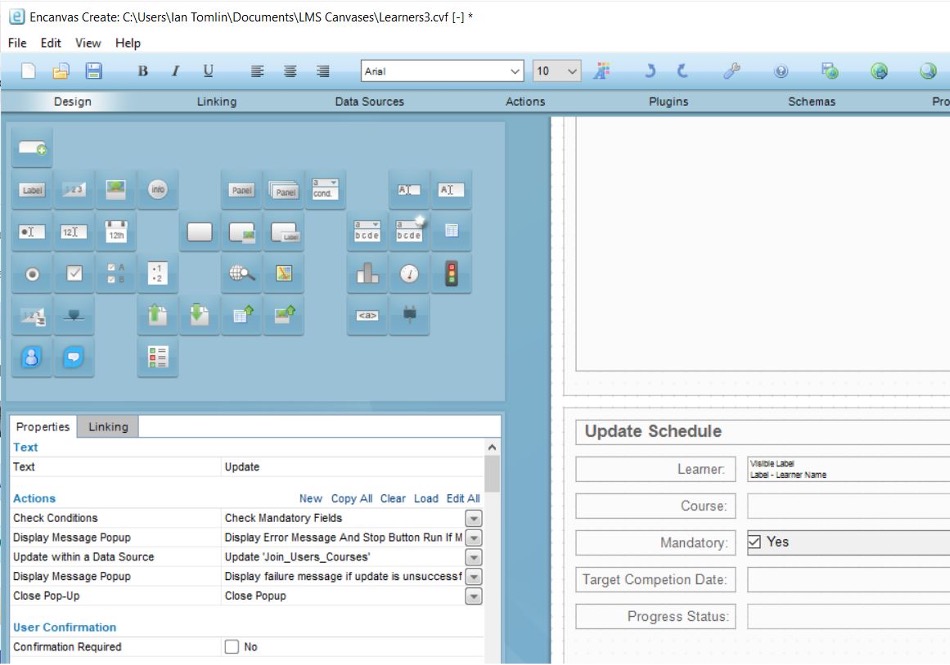
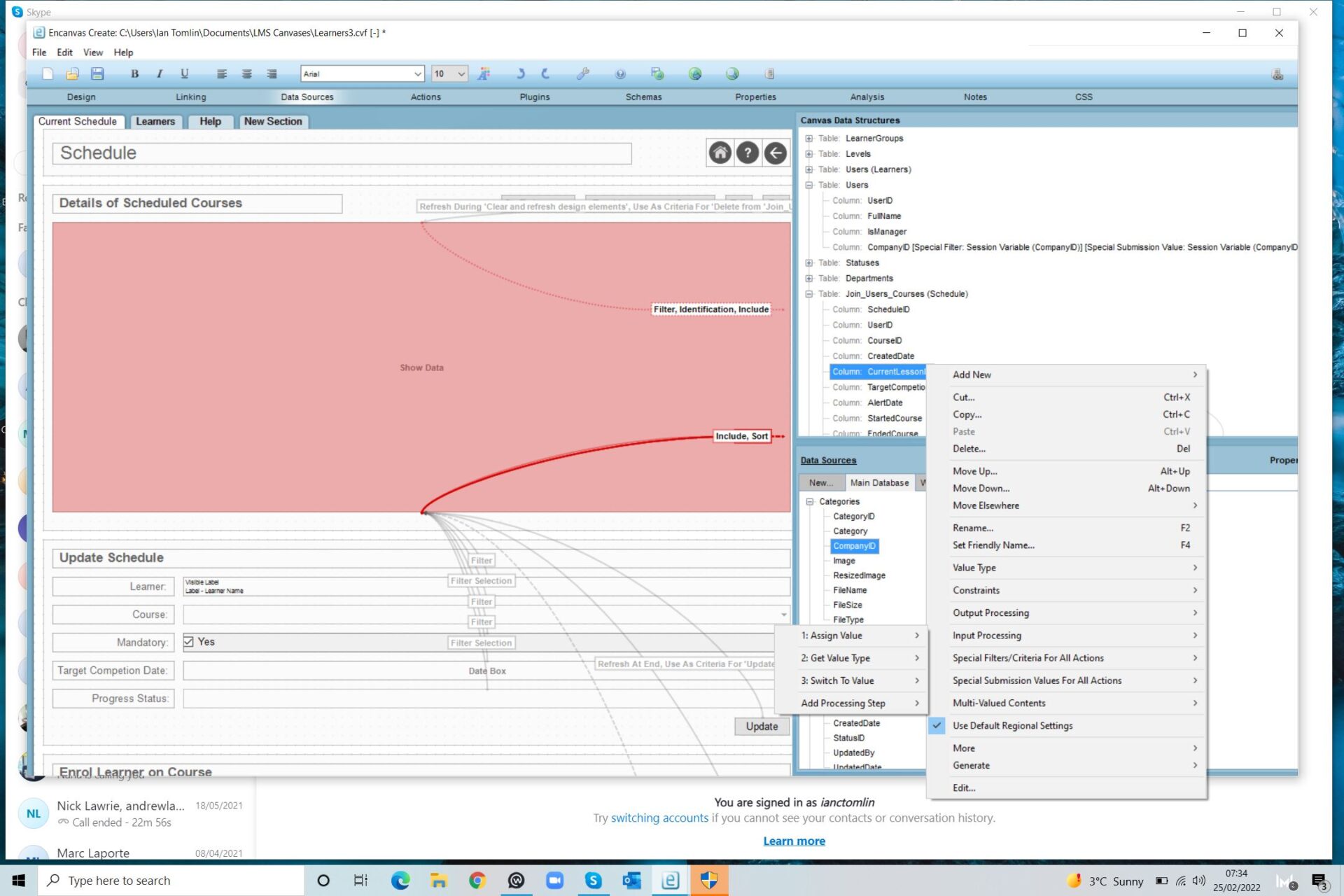
Coding and scripting is the biggest reason why software development has been traditionally unpredictable, costly and unable to produce best-fit software results. Encanvas uniquely automates coding and scripting. Our live wireframing approach means that business analysts can create the apps you need in workshops, working across the desk with users and stakeholders.
With a general recognition that business success is increasingly derived from the ability of an enterprise to master and leverage its data value, senior management teams are increasingly exploring ways to make sense of their operational performance through data. The ability to do away with data spaghetti; to re-use data – to harvest, cleanse, rationalize, and analyze it – has become a mission-critical need. A recent innovation that has added further data handling dexterity to Encanvas is HyperDrive. Launched in 2021, HyperDrive is an agnostic data plug-in enabler that turns any data type, DLL or plug-in into an integrated component of the Encanvas codeless design architecture.
With businesses using technology ever more to generate a competitive advantage in their market, it’s almost impossible to imagine a business model that doesn’t benefit from a great web app, or customer portal. This is causing organizations to become app factories, churning out custom apps as quickly as they can come up with ideas on how to improve customer experience, service new product lines, and cut back-office operating costs.
To orchestrate business processes, organizations are adopting aPaaS platforms to interface between:
1. Workers and computer systems (human-to-machine-interfacing-applications) and;
2. Computers (machine-to-machine-interfacing-applications).
Perhaps unsurprisingly, some processes require both human and machine interfaces. Additionally, Robotic Process Automation – the use of software robots to manage data flows and automate tedious tasks – has become a common characteristic of aPaaS platforms.
With a general recognition that business success is increasingly derived from the ability of an enterprise to master and leverage its data value, senior management teams are increasingly exploring ways to make sense of their operational performance through data. The ability to re-use data – to harvest, cleanse, rationalize, and analyze it – has become a mission-critical need.
An application Platform as a Service is the ecosystem used to orchestrate the end-to-end software development lifecycle (SDLC) for enterprise apps. While the focus of aPaaS is often towards speed of development, etc. arguably the most important selection factors come down to the hygiene issues of data integration, data security, deployability, scalability, data governance, and resilience.
The need for greater agility in IT systems, together with the rising influence of operational departments on enterprise software buying decisions, has led to the rise in application platforms that allow non-programmers to author applications. aPaaS platforms will generally adopt Low-Code, No-Code or sometimes even Codeless approaches to developing applications. In doing so, they reduce or remove the need to see or use programming code or script in the design, deployment and operational phases of the Software Development Cycle.
Encanvas is an enterprise software company that specializes in application Platform-as-a-Service (aPaaS) solutions and helping businesses to create above and beyond customer experiences. The platform removes the barrier between IT and the business. Coding and scripting is the biggest reason why software development has been traditionally unpredictable, costly and unable to produce best-fit software results. Encanvas uniquely automates coding and scripting. The software’s live wireframing approach means that business analysts can create the apps you need in workshops, working across the desk with users and stakeholders.
In most organizations a gap exists between inflexible Systems of Record – used to enforce good practice in common core back-office processes such as financial management, human resources, and customer relationship management – and demand for applications from departments, users, teams, customers, suppliers, and other stakeholders to support the fulfilment of a business model orchestration. A cloud aPaaS creates an umbrella across existing systems and fills the void in useful apps that workers, customers, suppliers, and other stakeholders want to use.
Now read: