EXPERIENCE ENCANVAS IN 60-MINUTES!
We’re always happy to walk you through Encanvas no matter where you are in the world.


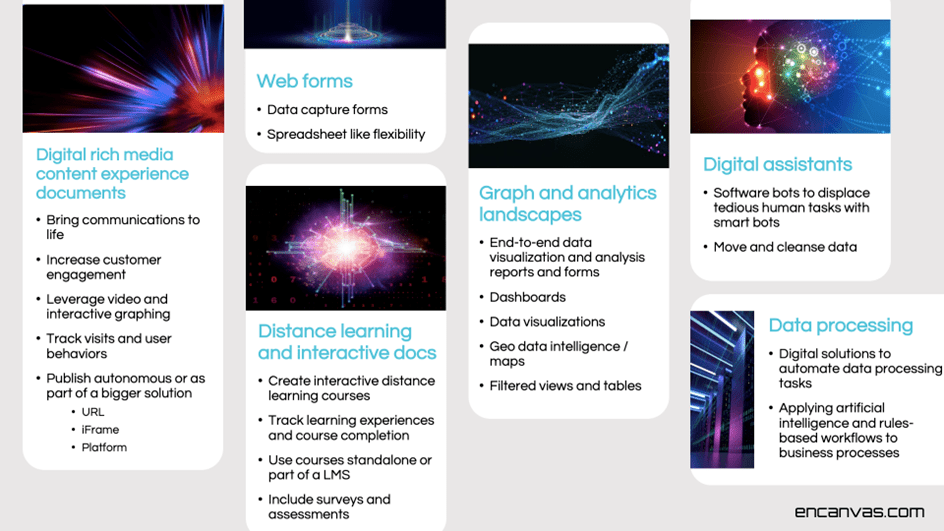
Digital documents are a revolutionary tool enabling digital transformation for businesses. Discover some of the types of digital documents you can create using Encanvas.
Content experience documents are all about engaging audiences in more impactful ways. A digital brochure (or eBook) combines rich media to produce persuasive, professionally crafted digital content. Rich media content—containing elements such as videos, testimonials, facts presented through interactive graphics, visualizations, etc.—increases stakeholder engagement, and improves customer experience, maximizing information consumption and use.
According to research into the opinions of 538 digital marketers conducted by Lemonlight in 2021, 81% plan to include video content in their marketing strategy over the next several years, while 94% said watching video content has helped them make a purchase decision at least once. Of those, 72% were swayed by a product video.
Distance learning has transformed education. Digital courseware makes it faster and easier for courseware designers to design and publish courses. Furthermore, once published, digital courseware is a lot easier to update. One of its advantages comes from the ability to track learning journeys; sometimes, recording training and training results is essential for compliance.
Digital documents bring distance learning course development into the digital age. Take existing PowerPoint courseware and upgrade it to digital online courses in minutes. Use courses stand-alone or leverage an eLearning platform to manage them.
Web forms are another digital document example, as they’re used to capture data from customers and turn back-office processes into self-service experiences. Automating processes in this way not only improves customer experience by making more services on-demand but also increases customer engagement while reducing service costs.
Often, human-in-the-loop processes are re-engineered with the minimum amount of effort or fuss. Having captured data, workflow rules can be automated by software bots that also track and record customer interactions into Customer Data Platforms.
We’ve made forms integration with websites simpler too. Using Encanvas digital documents, web forms can be implemented as stand-alone solutions or be closely integrated with existing data repositories. Publish forms as secured permissions-based iFrames within existing websites, or link to public or private forms using dedicated URLs for direct access.
Software bots are great at recording transactions, making ‘micro-decisions’ across the enterprise, for harvesting and cleansing data, and moving it between locations. Many of the tedious tasks previously performed by humans and spreadsheet-powered data processing applications can be displaced by enterprise-grade IT solutions made possible by digital documents.
While spreadsheets are versatile, they’re also labor-intensive. Give your knowledge workers more time to deliver value to customers and make a positive impact on innovation and business improvements by displacing spreadsheet apps with enterprise-grade digital document solutions. Our digital documents are powered by robots. That means, much of the heavy lifting that humans have previously done to capture, process, manage and analyze data can be discharged by software bots through automation.
Is your eCommerce front-end website fully automated with back-end systems? If so, then you’re ahead of the curve! Most organizations have a portion of their back-office data processing that goes ‘offline.’ This adds costs to service delivery costs while delaying customer requests and responses. Bottlenecks emerge and customer experience decays. The alternative is to use digital documents to bridge between systems and processes to create a ‘fully digital’ environment. The ability to leverage digital technologies to dramatically escalate time to value for digital transformations is increasingly being described as hyper-automation.
The possibilities to present and make sense of data using rich data visualization tools have grown dramatically thanks to innovations in cloud computing and big data tooling. Visualizations might come in the form of interactive maps used to track assets, parcels, people, vehicles or drones, or spatial charts and graphs that highlight key data attributes that would otherwise remain hidden to users.
Arguably, the single biggest reason businesses invest in enterprise IT is to formalize and automate processes. Not so long ago, the way to do this was to invest in Systems of Record (SoR)—like Oracle, SAP, and Microsoft—that promised best practice data processing ‘templates’ that catered for the majority need and offered the assurety of robust and resilient data management and processing.
Building enterprise software has never been easier thanks to advances in cloud Low-Code, No-Code, and Codeless aPaaS applications platforms.
How digital documents deliver small and wide data, allowing data-driven enterprises to optimize their business models and efficiency,
In this article, find out about our enterprise digital data fabric platform, what it is and why your business needs one.

Customer Data Integration (CDI) is the process of consolidating and then properly managing information about your customers from all available business sources, including all known contact details, financial data associated with that client, and information gathered through marketing activities.
Encanvas Customer Data Platform (CDP) incorporates advanced tooling for Customer Data Integration (CDI) as standard.
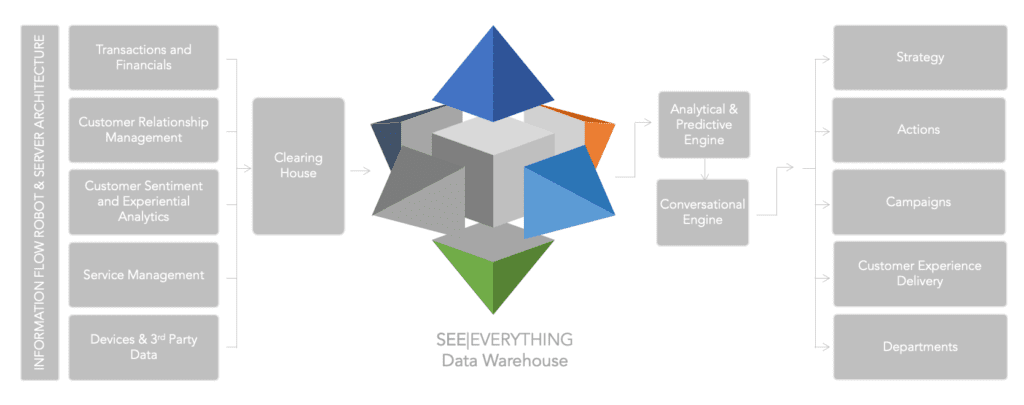
Most businesses want to maximize their customer experience by leveraging data. To achieve that requires the formation of an aggregated data-mart to present a single version of the truth. Preventing this ambition is the incumbent approach to data management, forged over the years as departments have invested in software to support discrete processes. Companies will use a blend of software applications and third-party tools along with their core enterprise resource planning system to fulfil their processes. This results in a fragmented and unregulated environment for data.
As businesses face an ever more regulated operating environment and greater competition in their local markets owing to the impact of Internet and mobile phone use, executives can ill afford to ignore the importance of installing appropriate controls over how customer and financial data is used, who uses it and how they use it.
An important business driver for integration services comes from the desire of executives to harvest data from across their enterprise in order to make informed decisions. The drive towards a data-driven culture demands that systems connect to one another. The integrity of data executives review, is a major sticking point.
A survey of 442 business executives around the world by Harvard Business Review found that corporate decision makers have major concerns about access to, availability of, and the quality of internal and outside data. The result is reduced confidence in their decision-making ability.
Moreover, nearly half of the global respondents said their lack of confidence stems from a lack of information or easy access to data. The findings are puzzling given the emergence of big data techniques, the proliferation of global networks and the sheer processing power contained even in mobile devices.
One reason for the disconnect between big data and decision making, the Harvard researchers found, is that “silos of data, typically imprisoned in customer, financial, or production systems, are frequently inaccessible by individuals outside the functional group.”
In this regard:
There are a series of discrete activities that need to be performed in order to bring customer data together from where it exists:
Not all data is accurate and complete all of the time. Take accounting information for example. Sometimes, invoicing lags behind sales. Taking a read of data at the wrong time in the accounting calendar can return unhelpful and potentially destructive information! It’s very important therefore, that architects of any data harvesting project possess a deep appreciation of the business they are serving.
Data integration is difficult to get right and has many technical challenges. One of them is systems latency. Sometimes, unless sessions are maintained, connections to third-party systems can drop.
Encanvas is an enterprise software company that specializes in helping businesses to create above and beyond customer experiences.
From Low Code to Codeless
Better than code-lite and low-code, we created the first no code (codeless) enteprise application platform to release creative minds from the torture of having to code or script applications.
Use Encanvas in your software development lifecycle to remove the barrier between IT and the business. Coding and scripting is the biggest reason why software development has been traditionally unpredictable, costly and unable to produce best-fit software results. Encanvas uniquely automates coding and scripting. Our live wireframing approach means that business analysts can create the apps you need in workshops, working across the desk with users and stakeholders.
When it comes to creating apps to create a data culture and orchestrate your business model, there’s no simpler way to instal and operate your enterprise software platform than AppFabric. Every application you create on AppFabric adds yet more data to your single-version-of-the-truth data insights. That’s because, we’ve designed AppFabric to create awesome enterprise apps that use a common data management substrate, so you can architect and implement an enterprise master data management plan.
Encanvas supplies a private-cloud Customer Data Platform that equips businesses with the means to harvest their customer and commercial data from all sources, cleanse and organize it, and provide tooling to leverage its fullest value in a secure, regulated way. We provide a retrofittable solution that bridges across existing data repositories and cleanses and organizes data to present a useful data source. Then it goes on to make data available 24×7 in a regulated way to authorized internal stakeholders and third parties to ensure adherence to data protection and FCA regulatory standards.
Encanvas Secure and Live (‘Secure&Live’) is a High-Productivity application Platform-as-a-Service. It’s an enterprise applications software platform that equips businesses with the tools they need to design, deploy applications at low cost. It achieves this by removing coding and scripting tasks and the overheads of programming applications. Unlike its rivals, Encanvas Secure&Live is completely codeless (not just Low-Code), so it removes the barriers between IT and the business. Today, you just need to know that it’s the fastest (and safest) way to design, deploy and operate enterprise applications.
Learn more by visiting www.encanvas.com.
Ian Tomlin is a management consultant and strategist specializing in helping organizational leadership teams to grow by telling their story, designing and orchestrating their business models, and making conversation with customers and communities. He serves on the management team of Encanvas and works as a virtual CMO and board adviser for tech companies in Europe, America, and Canada. He can be contacted via his LinkedIn profile or follow him on Twitter.
CIO article on Customer Data Integration
Blog article on CDI
Wikipedia article on data integration

Customer data is anything that identifies a customer, or indeed any associated data that results from customer interactions including purchases, transactions, and customer service communications.
A Customer Data Platform is an enterprise computer processing platform used to harvest, aggregate, cleanse, manage, process, analyze and output customer associated data. Data is pulled from multiple sources, cleaned and combined to create a single customer profile. This structured data is then made available to other marketing systems. Unlike a Customer Database, a Customer Data Platform extends its functionality to all aspects of the customer lifecycle. Normally it will include campaign management and the provisioning of multi-channel communications. Advanced systems will manage customer offers and promotions.
The CDP Institute defines a Customer Data Platform as “packaged software that creates a persistent, unified customer database that is accessible to other systems.” Basically it’s a prebuilt system that centralizes customer data from all sources and then makes this data available to other systems for marketing campaigns, customer service and all customer experience initiatives. Gartner defines CDPs as – ‘integrated customer databases managed by marketers that unify a company’s customer data from marketing, sales and service channels to enable customer modeling and drive customer experience.’ An encanvas, we see this as a narrow definition, given that Customer Data Platforms normally serve up insights to strategic teams and all departmental functions to shape processes and priorities.
Every business understands the impact of outstanding customer experience. Think of businesses like Amazon, whose singular purpose is obsessive Customer Fanaticism; placing the customer at the heart of everything it does. Even shareholders were taken aback when its founder Jeff Bezos explained that he was prepared to forego short-term profitability in exchange for an unbeatable customer experience. And he’s proven to be correct.
Like Amazon, if you want to delight customers with personalized offers then you will need to be world-class at capturing and making sense of lots of data about the customers you serve. Modern marketing methods rely on data to drive decision making. It eliminates the guesswork of content marketing because marketers know what motivates customers and the characteristics that profile the best-fit audience for their products and services.
Without a Customer Data Platform, the ability to appreciate the value and characteristics of customer relationships is rarely that straight-forward. In practice, data is stored in silos, whether organizational or technological, and this makes it challenging for companies to deliver consistent customer experiences.
An important business driver for integration services comes from the desire of executives to harvest data from across their enterprise in order to make informed decisions. The drive towards a data-driven culture demands that systems connect to one another. The integrity of data executives review, is a major sticking point.
A survey of 442 business executives around the world by Harvard Business Review found that corporate decision makers have major concerns about access to, availability of, and the quality of internal and outside data. The result is reduced confidence in their decision-making ability.
Moreover, nearly half of the global respondents said their lack of confidence stems from a lack of information or easy access to data. The findings are puzzling given the emergence of big data techniques, the proliferation of global networks and the sheer processing power contained even in mobile devices.
One reason for the disconnect between big data and decision making, the Harvard researchers found, is that “silos of data, typically imprisoned in customer, financial, or production systems, are frequently inaccessible by individuals outside the functional group.”
In this regard:
Your customer data has huge business value because it helps to improve your ability to engage customers in conversation, on topics they care about. Then, your marketing team can use customer insights to segment markets and develop tailored offers to specific groups of customers; to deliver personalized experiences, one customer, at a time. This attention to detail (and preference) has become a ‘killer-app’ in many consumer markets where buyers have so much choice.
“Customer Data Platforms help companies solve a huge and growing problem: the need for unified, accessible customer data. Like most packaged software, a CDP reduces risk, deploys faster, costs less, and delivers a more powerful solution than custom-built alternatives…With careful planning, a CDP will provide the foundation your company needs in the years ahead to meet customer expectations for exceptional personalized experiences.” — David Raab, Customer Data Platform Institute
In most businesses today, marketing teams are awash with data. The problem is, much of the data is spread across operating systems and platforms that have no means to present a single view of the customer. Only recently have senior management teams come to recognize the strategic importance of customer data and its role in delivering a competitive advantage.
As data volumes grow, and is spread across your organization and its partner ecosystem, you lose the ability to leverage it and gain a competitive advantage. Organizations come unable to assemble unified customer data.
Data quality is a huge problem. When the currency or completeness of is poor, the usefulness of insights is tested.
It’s common for operational systems not to populate all of the tables and rows that exist in back-office systems when they don’t directly benefit the specific process they serve. This can result in many of the harvested data-sets to be incomplete, or of poor quality. In consequence, organizations are unable to apply unified customer data in delivery systems.
To create high-quality data requires data to be cleansed and graded when sourced from operational systems. This requires specialist computer tooling, often driven by artificial intelligence technologies, used to vote on the best quality sources and graduate data as it is being harvested. According to the CDP Institute, something like 43% of business-to-business companies lack the ability to extract data from source systems.
Departments all benefit from a single view of the customer, but rarely can they agree who owns it and are prepared to share data to achieve it. Projects can easily be derailed as the result of inadequate budgets, poor cooperation across organizations, and a general lack of time in marketing and technology departments to commit effort into what is essentially a change management project.
Implementing a Customer Data Platform will gather data to create a unified data-mart that presents holistic landscape views of your customers and their interactions with your business – irrespective of where the data is held. The result is that all teams across the enterprise benefit from an improved understanding of what customers care about to segment more effectively, shape customer offers in more refined ways and fine-tune processes to deliver above and beyond (and personalized) customer experiences.
According to the most recent study by the CDP Institute, the top reasons that organizations buy CDP solutions are to:
For most organizations, the ultimate test of whether a Customer Data Platform is delivering optimal outcomes lies in its ability to do three things exceedingly well:
Most organizations today structure their data within the operating departments that manage processes. This only serves to fragment customer data. A Customer Data Platform requires a rethink in the way data is managed, to ensure that all facets of the customer world are incorporated into the customer data model not limited to:
One of the challenges in putting together a Customer Data Strategy is the broad cross-section of stakeholders with a voice on what the end-game should look like. The key stakeholders will tend to be any of the following:
There are typically five main components of a Customer Data Platform architecture. Note, the terminology used here is formed around the Encanvas CDP but alternative solutions follow a similar path:
Here are some of the common obstacles we’ve encountered through previous projects implementing Encanvas as a Customer Data Platform:
A single view of the customer is only as effective as it is comprehensive and actionable. In the first place, the number of data sources available to a CDP is critical to the richness of insight it offers. You will want to have a comprehensive and current data set, along with the broadest platform to make use of the insights. If a Customer Data Platform has access to website data alone, then gaps will exist in the knowledge of customer interactions, transactions, etc. – and it will be impossible to accurately judge profitability. When solutions only use data to personalize a customer’s website experience, there are crucial gaps in customer experience delivery that extends beyond it – such as customer service and support.
Market analysts offer conflicting data on the size and potential of the CDP market.
Early-stage reporting from researchers at Raab Associates – attributed to having coined the category term in 2014 – made the prediction in 2017 that, after analyzing 27 CDP vendors that collectively generated more than $300 million in revenue – Customer Data Platforms (CDP) would reach $1 billion by 2019. According to a Marketsandmarkets.com survey, the customer data platform market is predicted to grow from $639.9 million in 2017 to reach $3,265.4 million by 2023 at a Compound Annual Growth Rate (CAGR) of 29.3% during the forecast period. The base year for the study is 2017 and the forecast period is 2018–2023. The customer data platform (CDP) is said to have a potential scope for growth in the years to come due to increasing adoption of the customer data platform for omni-channel customer experience and demand for real-time data availability. Researchandmarkets.com suggest major growth drivers for the market include an increasing demand for omni-channel experience and actionable insights by marketers and effective tracking of customers to understand their behavior for target marketing activities, and increasing pressure on CMOs to deliver personalized content spurring the demand for real-time data availability. Gartner, one of the generally most trusted enterprise IT analysts, have incorporated Customer Data Platforms into a broader category called Customer Experience and Relationship Management Software. They say Worldwide spending on customer experience and relationship management (CRM) software grew 15.6% to reach $48.2 billion in 2018, according to research from Gartner, Inc. CRM remains both the largest and the fastest growing enterprise application software category.
Gartner sees much of the data science aspects of Customer Data Platforms integrated within its data science and machine learning (DSML) platform category. Gartner defines a DSML platform as a core product and supporting portfolio of coherently integrated products, components, libraries and frameworks (including proprietary, partner and open source). Its primary users are data science professionals. These include expert data scientists, citizen data scientists, data engineers and machine learning (ML) engineers/specialists. Players in this space include Alteryx, Anaconda, Databricks, Dataiku, DataRobot, Domino, Google, H20.ai. IBM, KNIME, MathWorks, Microsoft, RapidMiner, SAS, TIBCO and Altair.
To define the DSML market and score vendors, Gartner has determined fifteen critical capabilities.
In addition to Encanvas, the following vendors are active in the CDP market include Oracle, SAP, Salesforce, Adobe, Nice, SAS Institute, Tealium, Segment, Zaius, AgilOne, ActionIQ, BlueConic, Ascent360, Evergage, Lytics, mParticle, NGDATA, IgnitionOne, Signal, Usermind, Amperity, Reltio, Ensighten, Fospha, and SessionM.
Encanvas is an enterprise software company that specializes in helping businesses to create above and beyond customer experiences.
From Low Code to Codeless
Better than code-lite and low-code, we created the first no-code (codeless) enterprise application platform to release creative minds from the torture of having to code or script applications.
Use Encanvas in your software development lifecycle to remove the barrier between IT and the business. Coding and scripting is the biggest reason why software development has been traditionally unpredictable, costly and unable to produce best-fit software results. Encanvas uniquely automates coding and scripting. Our live wireframing approach means that business analysts can create the apps you need in workshops, working across the desk with users and stakeholders.
When it comes to creating apps to create a data culture and orchestrate your business model, there’s no simpler way to install and operate your enterprise software platform than AppFabric. Every application you create on AppFabric adds yet more data to your single-version-of-the-truth data insights. That’s because, we’ve designed AppFabric to create awesome enterprise apps that use a common data management substrate, so you can architect and implement an enterprise master data management plan.
Encanvas supplies a private-cloud Customer Data Platform that equips businesses with the means to harvest their customer and commercial data from all sources, cleanse and organize it, and provide tooling to leverage its fullest value in a secure, regulated way. We provide a retrofittable solution that bridges across existing data repositories and cleanses and organizes data to present a useful data source. Then it goes on to make data available 24×7 in a regulated way to authorized internal stakeholders and third parties to ensure adherence to data protection and FCA regulatory standards.
Encanvas Secure and Live (‘Secure&Live’) is a High-Productivity application Platform-as-a-Service. It’s an enterprise applications software platform that equips businesses with the tools they need to design, deploy applications at low cost. It achieves this by removing coding and scripting tasks and the overheads of programming applications. Unlike its rivals, Encanvas Secure&Live is completely codeless (not just Low-Code), so it removes the barriers between IT and the business. Today, you just need to know that it’s the fastest (and safest) way to design, deploy and operate enterprise applications.
Learn more by visiting www.encanvas.com.
Mason Alexander is a senior consultant specializing in helping organizational leadership teams to grow by implementing enterprise software platforms that improve data visibility, process agility; and organizational learning – creating an enterprise that learns and adapts faster. He writes on subjects of change management, organizational design, rapid development applications software, and data science. He can be contacted via his LinkedIn profile.
Marketsandmarkets CDP market sizing research report
Prenewswire reprint of market sizing report
cmswire.com ‘Keep your eye on Customer Data Platforms’ article
CDPinstitute website offering more details about Customer Data Platforms